Published May 6, 2026
Her name was Hind Rajab. She was six years old.
She called the Palestinian Red Crescent on January 29, 2024, from inside a car surrounded by Israeli tanks in Gaza City. Her family had just been killed around her. She was trapped with their bodies for hours. The Red Crescent dispatched an ambulance. Israeli forces killed the paramedics who came for her. When rescue workers reached the car twelve days later, they found Hind’s body. She had 335 bullets in her.
His name was Hassan Badawi. He was 31 years old.
He was a Lebanese Red Cross paramedic who had served in humanitarian missions since 2012. On April 15, 2026, he was responding to casualties in Beit Yahoun, southern Lebanon, when an Israeli drone struck while he was carrying a patient from an ambulance. His mission had been officially communicated to ensure safe passage. He was killed while performing a humanitarian duty.
Her name was Amal Khalil. She was 43 years old.
She was a Lebanese journalist for Al-Akhbar newspaper, reporting from Tayri in southern Lebanon on April 23, 2026. After an initial airstrike, she took shelter in a nearby building. That building was then directly struck. Rescue efforts were delayed due to ongoing shelling and restricted access. By the time emergency teams could reach her, she was dead.
His name was Roozbeh Vadi. He was 40 years old.
He was my cousin. He was an Iranian nuclear scientist executed by hanging on August 6, 2025, at Evin Prison in Tehran. He had been detained for 18 months, tortured, shown images of his arrested mother to force a confession, and subjected to two sham trials—both overseen by Judge Abolghasem Salavati and his son. He was executed overnight after the 12-day Iran-Israel war, despite no credible evidence against him.
His name was Alejandro Carranza Medina. He was 40 years old.
He was a Colombian fisherman from Santa Marta. On September 15, 2025, his fishing boat suffered mechanical failure in the Caribbean Sea. The U.S. military bombed it as an alleged drug vessel. No drugs were ever proven to be aboard. His wife Katerine Hernández says: “Why did they take his life like that? Fishermen have the right to live. Why didn’t they just detain them?”
I know these stories because I documented them.
Not as numbers. Not as statistics in casualty reports. But as full profiles on ParentsPlea.com with names, ages, photographs, causes of death, news sources, and—when possible—their families’ pleas for the world to remember them.
These five people are among 142,000+ documented on ParentsPlea.com.
Each one has a full profile. Each one has a story. Each one deserves more than a line in a press release about “approximately 30,000 casualties.”
People ask me why I built this database. Why I spend time collecting photographs, verifying sources, building profiles instead of citing statistics.
There are three reasons.
And while European leaders meet in Yerevan this week to discuss “unity” and “stability,” I want to explain what those three reasons are—because they’re about something bigger than any summit agenda.
Reason One: Justice Requires Names
You cannot prosecute a statistic.
When human rights lawyers prepare cases for the International Criminal Court, they don’t submit charts showing casualty trends. They submit witness testimony. Forensic evidence. Documentation linking specific deaths to specific actions by specific individuals.
Justice is granular. It requires precision.
The petition I launched calling for prosecution of Amazon, Google, Microsoft, Oracle, and Palantir executives isn’t based on abstract claims about “tech industry complicity.” It’s based on documented evidence linking specific infrastructure contracts to specific AI systems used in specific military operations that killed specific people.
Gospel. Lavender. Where’s Daddy. Project Nimbus.
These aren’t hypothetical systems. They’re operational tools deployed at scale—generating bombing targets at rates no human review process could keep pace with, tracking individuals to their family homes for maximum lethality, storing and processing the surveillance data that makes precision targeting possible.
Over 30,000 children are dead in Gaza alone.
Not “approximately.” Not “estimated.” Over 30,000 documented children with names, ages, and families who are still alive to mourn them.
When prosecutors build cases, they won’t reference “approximately 30,000.” They’ll reference individuals:
- Hind Rajab, age 6, killed January 29, 2024, after calling for help
- Hassan Badawi, age 31, killed April 15, 2026, while carrying a patient
- Amal Khalil, age 43, killed April 23, 2026, while reporting as a journalist
ParentsPlea.com exists to provide that granularity.
Every profile is a potential exhibit in a future trial. Every photograph is evidence. Every news source citation is documentation that this person existed, died under these circumstances, and their death was recorded by credible media.
You can dismiss 30,000 as a number. You cannot dismiss 30,000 names with faces.
Reason Two: Reparations Require Accounting
The second reason is economic.
When Germany paid Holocaust reparations, the Claims Conference didn’t negotiate based on estimated death tolls. They documented individual survivors and victims. They traced assets. They identified heirs.
Reparations require accounting.
If tech companies are ever held liable for their role in weapons systems that killed civilians—and I believe they will be—the legal question won’t be: “How much should they pay for approximately 30,000 deaths?”
The legal question will be: “Which deaths can be directly linked to infrastructure they provided? Who are the surviving family members? What compensation is owed to each family?”
Every international court that has awarded damages in mass atrocity cases has required individual victim documentation.
You cannot write a check to “the people of Gaza.” You write checks to families.
ParentsPlea.com is building that accounting system.
Each profile documents:
- Full name
- Age at death
- Date and location
- Cause of death (with sources)
- Family information when available
- Photographs
- Family pleas
When Hassan Badawi’s family files a claim against the companies whose infrastructure enabled the targeting system that killed him while he was carrying a patient from an ambulance, they will need documentation proving:
- Hassan existed
- He died on April 15, 2026
- He died as a result of military action
- That action used systems provided by specific companies
ParentsPlea.com will provide that documentation.
Not for Hassan alone. For Amal. For Hind. For the 30,000+ children. For the hundreds of aid workers and journalists killed while performing their duties.
For every documented victim whose death can be traced to systems enabled by American tech company infrastructure.
Reason Three: Memory Refuses Erasure
The third reason is the most important.
I’m Iranian. I left in 1986 when I was eleven years old. My family fled during the Iran-Iraq war—a conflict that killed over a million people.
Do you know their names?
Neither do I. Because no one documented them the way ParentsPlea documents deaths today.
History records the Iran-Iraq war as “approximately one million casualties.” That approximation is a form of erasure. Those million people had names, faces, families who loved them. But because their deaths were recorded as statistics instead of individuals, they’ve been reduced to a number in a history book.
I refuse to let that happen again.
My cousin Roozbeh Vadi was executed by the Islamic Republic after 18 months of detention, torture, and forced confession. His trials were overseen by a father-and-son pair of judges—Abolghasem Salavati and his son Mohammad Ibrahim Salavati. This level of nepotism in a judicial system is obscene. The junior judge would never dare contradict his father’s verdict.
Roozbeh was never politically active. He was a scientist devoted to empowering the Iranian people through peaceful nuclear energy. We didn’t know where he was during his imprisonment. We didn’t know his mother had also been jailed and used to force his confession. We learned of his death the same way the world did: through news reports.
He deserved better than that.
Hassan Badawi deserved better than being killed while carrying a patient from an ambulance.
Amal Khalil deserved better than being killed while reporting the truth.
Hind Rajab deserved better than 335 bullets while trapped in a car asking for help.
Alejandro Carranza deserved better than being bombed at sea while his fishing boat was stranded with mechanical failure.
If we document them as “30,000 casualties” or “hundreds of aid workers killed” or “dozens of journalists targeted,” they become political talking points. Numbers people debate.
But if we document them by name—that’s different.
You can debate numbers. You cannot debate Hind.
You can minimize statistics. You cannot minimize the audio recording of a six-year-old asking paramedics to come get her before the tanks close in.
You cannot minimize Hassan Badawi’s colleagues at the Lebanese Red Cross saying he was killed while carrying a patient.
You cannot minimize Amal Khalil’s editor saying she was killed while reporting.
Documentation is resistance to erasure.
Every profile on ParentsPlea.com is an act of witness. It says: this person existed. They mattered. They were loved. And their death was not inevitable—it was the result of specific decisions made by specific people using specific tools provided by specific companies.
What I Hope ParentsPlea Becomes
Right now, ParentsPlea.com has 142,000+ profiles.
The majority are from Palestine—both before and after October 7, 2023.
Some are from Lebanon.
Some are from Iran.
Some are from Colombia, killed in U.S. military operations.
Some are from the United States (police brutality cases).
But this isn’t just about Palestine. It’s not just about American foreign policy.
ParentsPlea is about a principle: Every death at the hands of state violence or corporate-enabled violence deserves documentation with the same rigor we’d give to a CEO’s biography.
When a tech executive dies, their Wikipedia page appears within hours. Full career history. Photographs. Quotes from colleagues. Links to major accomplishments.
When a child dies in a military operation enabled by that executive’s company, they’re recorded as a number in a casualty report—if they’re recorded at all.
That asymmetry is a choice.
I’m choosing differently.
I hope ParentsPlea becomes what the Yad Vashem database is for Holocaust victims: a permanent, searchable record that refuses to let these deaths be forgotten or minimized.
I hope families twenty years from now can search for their loved ones and find not just a name in a casualty list, but a profile that preserves their memory.
I hope prosecutors building cases against tech executives can use ParentsPlea’s documentation to establish individual harm.
I hope reparations courts can use ParentsPlea’s accounting to identify heirs and calculate damages.
And I hope—more than anything—that this database stops growing.
That we reach a point where tech companies are held accountable, weapons sales are conditioned on human rights compliance, and universal jurisdiction is exercised consistently enough that mass atrocities become prosecutable in real-time instead of decades later.
But until then, I will keep documenting.
Why This Matters While Leaders Meet in Yerevan
This week, 48 heads of state are meeting in Yerevan, Armenia, to discuss “unity and stability in Europe.”
They will talk about democratic resilience. Economic security. Digital transformation.
They will not talk about Hind Rajab.
They will not talk about Hassan Badawi.
They will not talk about Amal Khalil.
They will not talk about the 142,000+ people documented on ParentsPlea.com.
They will not ask whether the tech companies they’re partnering with for “digital sovereignty” are the same companies providing infrastructure for targeting systems that killed aid workers, journalists, and children.
But I will keep asking.
And I will keep documenting.
Because justice requires names. Reparations require accounting. And memory refuses erasure.
How You Can Help
- Visit ParentsPlea.com
See the profiles. Read the names. Look at the photographs. Understand that these are not statistics—these are people whose families asked the world to remember them.
- Share Specific Stories
When someone says “30,000 casualties,” respond with a name:
- Tell them about Hind Rajab, age 6, who called for help while trapped with her family’s bodies
- Tell them about Hassan Badawi, age 31, killed while carrying a patient from an ambulance
- Tell them about Amal Khalil, age 43, killed while reporting as a journalist
- Tell them about Roozbeh Vadi, age 40, executed after forced confession and torture
- Tell them about Alejandro Carranza, age 40, killed at sea while fishing
Statistics allow emotional distance. Names demand accountability.
- Support the Petition
I’ve launched a petition calling on Spain to prosecute Amazon, Google, Microsoft, Oracle, and Palantir executives under universal jurisdiction.
Every signature strengthens the legal and political pressure for accountability.
Sign at: ForeverPeaceNow.com/Petition
Petition signers receive a free copy of my forthcoming book: No Ethics In Big Tech: An Insider’s Case Against Silicon Valley’s War on Humanity—and the Fight to Make Them Pay.
- Demand Your Government Act
Spain doesn’t have to act alone. Canada can investigate. France can. Germany can. Every nation where these companies operate can exercise universal jurisdiction.
Find your representatives. Ask them: “Are you aware that [Company Name] operates in our country while providing infrastructure for military targeting systems? Will you support an investigation under universal jurisdiction?”
Final Thought
I spent 25 years in Silicon Valley working commercial Big Data and Analytics partnerships at Amazon Web Services. I sat in meetings with Andy Jassy and executives who signed the contracts I never touched—the government and military deals that fund weapons systems.
I saw the culture. I saw the pressure. I saw what happened to employees who raised ethical concerns.
You don’t need blood on your hands to know what the machine does.
And then I watched those same companies turn their infrastructure toward violence at scale, and I understood:
Technical excellence without moral accountability isn’t progress. It’s just a more efficient way to cause harm.
ParentsPlea.com is my answer to that realization.
It’s not enough to oppose these systems in theory. It’s not enough to write blog posts or give speeches.
You have to document. You have to preserve. You have to build the evidence foundation that future prosecutors will need.
So that twenty years from now, when someone asks: “Did Silicon Valley know? Did they have evidence? Did anyone try to hold them accountable?”
The answer will be yes.
Because we documented every name.
Hind. Hassan. Amal. Roozbeh. Alejandro.
And 141,995 others.
Learn more:
- Visit: ParentsPlea.com — 142,000+ profiles, not statistics
- Watch: Forever Peace Now documentary at ForeverPeaceNow.com
- Sign: Universal jurisdiction petition at ForeverPeaceNow.com/Petition
Hashtags: #ParentsPlea #UniversalJurisdiction #NeverAgainMeansNeverAgain #DocumentaryEvidence
Vahid Razavi is a Silicon Valley technology veteran, digital rights activist, producer of the documentary Forever Peace Now, and author of Ethics in Tech and Lack Thereof and The Age of Nepotism. He is currently completing his third book, No Ethics In Big Tech: An Insider’s Case Against Silicon Valley’s War on Humanity — and the Fight to Make Them Pay. Available to petition signers upon completion.
Add your name to the plea for accountability.
Stand with the families demanding truth, protection, and an end to the violence that takes their loved ones.
Sign the Petition →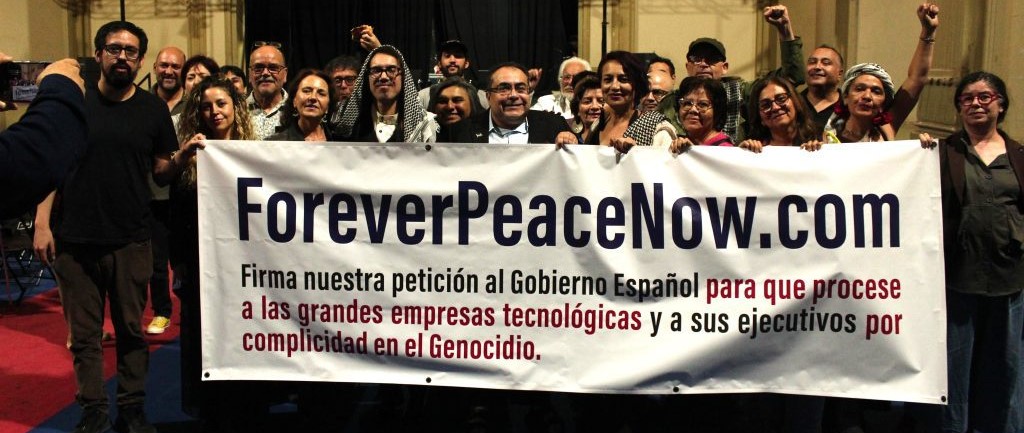 Supporters rally behind the petition for accountability.