At Rest
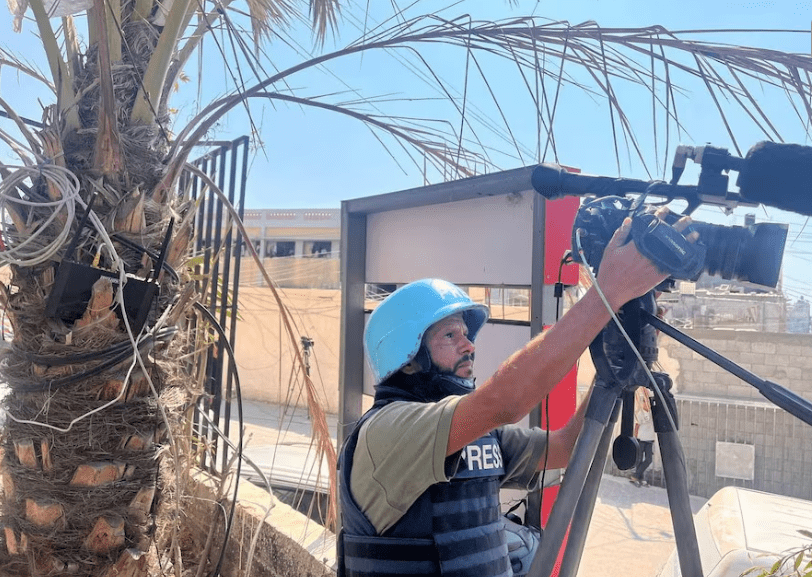
Hussam al-Masri was a Palestinian cameraman who worked as a contractor for Reuters in Gaza. Dedicated to documenting the war despite the immense risks, he was part of the small group of local journalists relied upon by international news agencies to show the world the realities inside Gaza. Known for his commitment to visual reporting, he contributed to frontline coverage under extremely dangerous conditions, often from hospitals and sites of bombardment where civilians and medical workers were struggling to cope with the ongoing crisis.
Hussam al-Masri lived and worked in Gaza, where local journalists often bear the greatest burden of reporting due to Israel’s restrictions on foreign media access. As a Reuters contractor, al-Masri operated behind the camera, helping capture footage that shaped global understanding of the war. His work, though frequently anonymous, was crucial to international reporting, as images and video feeds from Gaza were one of the few ways the outside world could witness the devastation. Like many of his colleagues, Hussam faced the daily reality of displacement, shortages of food, and the danger of constant bombardment, yet he continued to document the conflict. His death highlights the peril journalists in Gaza face, as the region has become the deadliest place in the world for media workers.
Hussam al-Masri was killed in an Israeli airstrike on Nasser Hospital in Khan Younis, Gaza, on August 25, 2025, while carrying out his journalistic duties.
On August 25, 2025, Israeli forces carried out two successive strikes on Nasser Hospital in Khan Younis. Journalists, including Hussam, had rushed to cover the aftermath of the first strike, a common practice in Gaza where reporters document immediate civilian casualties and damage. As they gathered on the hospital’s exterior staircase, a second, more powerful strike hit the same location. Hussam al-Masri, along with four other journalists, was killed instantly in the blast. The Israeli military later claimed the strikes targeted a Hamas surveillance camera on the hospital roof, but international media organizations, including Reuters, AP, and Al Jazeera, condemned the attack and demanded accountability, stressing that journalists were clearly marked and present in their professional capacity.
His family joined broader appeals from the Foreign Press Association and media outlets demanding international leaders to step in, saying: “Too many journalists in Gaza have been killed by Israel without justification. This must be a watershed moment. We appeal to international leaders: Do everything you can to protect our colleagues. We cannot do it ourselves.”
This record exists so that Hussam al-Masri, and all who are named in this archive, are never reduced to a number.
More lives from the archive.