At Rest
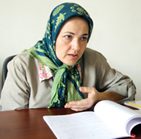
Haleh Sahabi (4 February 1958 – 1 June 2011) was an Iranian humanitarian, democracy activist, and women's rights advocate. She was the daughter of Ezzatollah Sahabi, a former Iranian MP and opposition figure, and the granddaughter of Yadollah Sahabi. Haleh played a significant role in advocating for peace and democracy in Iran and was a member of the "Mothers for Peace" group.
Personal Life: Born in Tehran, she was married to Taghi Shamekhi and had three children: a son, Yahya, and two daughters, Amene and Asie.
Activism and Arrest: Sahabi was a vocal advocate for human rights and democracy. She was arrested in August 2009 during a protest against President Mahmoud Ahmadinejad's second inauguration. She was sentenced to two years in prison for "spreading propaganda against the regime" and "disrupting public order," but was temporarily released to attend her father's funeral in May 2011.
Full Name: Haleh Sahabi
Born: 4 February 1958
Died: 1 June 2011 (aged 53)
Cause of Death: Cardiac Arrest (disputed cause)
Nationality: Iranian
Spouse: Taghi Shamekhi
Children: Yahya (son), Amene (daughter), Asie (daughter)
Parents: Ezzatollah Sahabi (father), Zarrindokht Ataei (mother)
Early Life and Background:
Haleh Sahabi was born in Tehran, Iran, to Ezzatollah Sahabi, a prominent Iranian opposition leader and former member of the Iranian Parliament, and Zarrindokht Ataei, whose maternal uncle was Mehdi Bazargan, a key figure in post-revolutionary Iran. Haleh grew up in an environment where political activism and the quest for social justice were prominent values. Her upbringing in a family with a history of political involvement influenced her later commitment to activism.
Activism and Advocacy:
Sahabi was deeply involved in the social and political movements in Iran, particularly advocating for women's rights, human rights, and democracy. She was a member of the Mothers for Peace group, a collective of Iranian women who campaigned against war and violence in Iran, calling for peace and justice. Haleh was also committed to the cause of political prisoners, women’s rights, and reforming the Iranian political system.
Her activism was rooted in the belief that human rights should be central to any political system, and she worked tirelessly to highlight the plight of the oppressed and marginalized communities in Iran.
Arrest and Imprisonment:
In August 2009, during protests following the disputed re-election of President Mahmoud Ahmadinejad, Haleh Sahabi was arrested in front of the Iranian Parliament, where she and other activists had gathered to express their opposition to the regime. She was sentenced to two years in prison for "spreading propaganda against the regime" and "disrupting public order." Sahabi was temporarily released from prison in May 2011 to attend the funeral of her father, Ezatollah Sahabi, a revered figure in the Iranian opposition.
Despite her release, Sahabi remained under government scrutiny for her activism, and she faced continued persecution and harassment. Her father's funeral, however, would prove to be the last public event in which she was involved.
Death at Father’s Funeral:
On 1 June 2011, during the funeral of her father, Haleh Sahabi’s life was tragically cut short. As mourners gathered to pay their respects, tensions escalated when security forces, including members of the Basij militia, attempted to disrupt the ceremony. Reports from eyewitnesses, including her son Yahya Shamekhi and activists such as Ahmad Montazeri and Hamed Montazeri, indicated that Sahabi had been struck by a member of the security forces.
According to these witnesses, Sahabi collapsed after the confrontation. Yahya Shamekhi recounted that, during the ceremony, security forces attempted to seize her father’s body, which caused an emotional and physical altercation. Sahabi reportedly fell unconscious shortly after being struck by a member of the security forces.
The official explanation from the Iranian government was that Sahabi died of natural causes due to heart problems, exacerbated by "stress and hot weather." However, this explanation has been widely disputed. Many eyewitnesses and medical professionals suggested that her death was caused by physical trauma, possibly a result of the beating she received. An anonymous person claiming to be a surgeon who tried to save her in a Tehran clinic stated that Sahabi exhibited signs of internal bleeding, particularly in the abdominal area, which they believed had caused her collapse.
Some sources suggested that Sahabi's death could have been avoided had she received medical attention sooner, with some claiming she showed signs of acute abdomen, which could have been treated had she been promptly examined. An autopsy was not conducted to determine the exact cause of her death, and her body was taken by authorities immediately after her passing, adding to suspicions surrounding the circumstances of her death.
Burial and Government Response:
After her death, the Iranian government did not allow her family to hold a proper mourning ceremony. Sahabi’s body was seized by the authorities and buried in a small, remote cemetery in Lavasan, Tehran, without the consent or knowledge of the family. The burial took place in the late hours of the night, under heavy surveillance. Family and close friends were forced to attend the ceremony under duress, and no public mourning or investigation into the cause of her death was allowed.
The lack of an autopsy and the forced nature of her burial led to further outrage, both domestically and internationally. The Iranian government maintained its stance that her death was due to natural causes, but many believed that her death was a result of the treatment she endured at the hands of the security forces.
Legacy and International Outcry:
Sahabi’s death sparked widespread protests and international condemnation. On 4 June 2011, several hundred protesters gathered in Tehran to mourn her loss and demand accountability, but they were met with a heavy presence of security forces. The authorities used batons and fired shots in the air to disperse the crowd, arresting several protesters in the process.
International human rights organizations, including Amnesty International and Human Rights Watch, demanded that the Iranian government conduct a full investigation into Sahabi’s death and hold those responsible accountable. Both the US and UK governments also called for an investigation into the incident.
In the aftermath of Sahabi’s death, the International Campaign for Human Rights in Iran issued a statement condemning the Iranian government for its actions, which they described as disrespecting the Iranian people’s rights to mourn and grieve freely. The incident highlighted the growing concerns about human rights abuses and repression under the Iranian regime.
Hoda Saber and the Hunger Strike:
The death of Haleh Sahabi also led to the tragic death of another prominent activist, Hoda Saber, who was in prison at the time. Saber, a nationalist-religious figure, went on a hunger strike to protest Sahabi’s death and the Iranian government’s crackdown on peaceful protesters. Saber’s hunger strike ultimately led to his own death in prison, further highlighting the brutal treatment of activists in Iran. His death was also met with outrage, as it was revealed that prison officials had neglected his medical needs, leading to his fatal heart attack.
cardiac arrest
After Haleh Sahabi's death, her surviving relatives, particularly her son Yahya Shamekhi and her sister Firouzeh Sahabi, expressed deep outrage and grief. They accused Iranian security forces of causing her death through physical assault and negligence. Yahya Shamekhi described how his mother collapsed after a confrontation with the Basij militia at the funeral and was later pronounced dead from a heart attack. He and other family members rejected the official explanation from the government, which claimed she died due to heart problems. The family demanded a full investigation into the circumstances of her death, calling for accountability for the actions of security forces during the funeral. They also criticized the authorities for not allowing an autopsy and for hastily burying her in the middle of the night without proper family consent.
This record exists so that Haleh Sahabi, and all who are named in this archive, are never reduced to a number.
More lives from the archive.